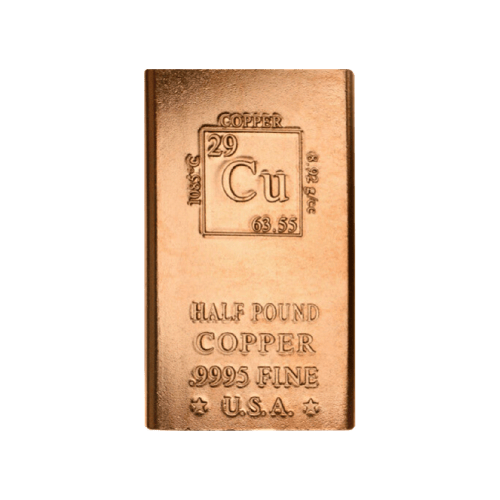
Lingot de cuivre Elemental de 1/2 livre
Related products
Ces lingots de cuivre rustiques offrent un impressionnant poids de 1/2 livre de cuivre fin à 999 avec un aspect minimal mais toutefois élégant. Le cuivre n'est pas considéré comme un métal précieux contrairement à l'or, l'argent et le platine. Mais sa multitude d'applications industrielles confère à ce métal une grande liquidité et une demande accrue.
LES CARACTÉRISTIQUES DU LINGOT
- Composé de 1/2 lb de cuivre fin 9995
- Avers : contient le poids et la pureté du métal ainsi que le tampon du cuivre de la table périodique et le cachet « USA »
- Revers : le revers de ce lingot est vierge et comporte les striations et les lignes de texture naturelles provenant du procédé de refroidissement et que l'on peut observer des deux côtés
Le cuivre est un métal utilisé par les hommes depuis des milliers d'années. Bien qu'il n'ait pas le statut de métal précieux, la haute conductivité et le prix abordable de ce matériau rougeâtre en font une excellente option pour une variété d'applications industrielles à grande échelle dans de multiples secteurs tels que la construction, le médical, l’électricité, la frappe de monnaie, la soudure et bien d'autres encore.
Ces lingots sont composés de dix livres de cuivre fin à 999. Le symbole « Cu » vient du mot latin « cuprum ». Le nom original, « aes cyprium », était une référence à l'île de Chypre où ce matériau était abondant. Au fil du temps, le mot se transforma pour devenir « cuprum ».
