
Pièce 1/2 once d'or Les débuts du Canada : Nouvelle France 2020 | Monnaie royale canadienne
Related products
THIRD COIN IN THE SERIES! New France, crafted in 99.99% pure gold
In the early 17th century, the first colonies of New France began to appear as Europeans shifted their attention away from fish that could be harvested at sea to a new source of wealth that resided on shore: fur. Fur-trading posts required permanent, fortified settlements with a variety of people to provide the skills, services and products necessary to sustain the community. When Samuel de Champlain began building his Habitation at today’s Quebec City, he knew that two critical services could be procured from one man: Louis Hébert.
Champlain had met Hébert on two previous expeditions. Hébert was an apothecary and an agriculturalist, and he accepted the position as the colony’s physician and surgeon. Hébert was also given land where he agreed to plant crops so the Habitation could become self-sufficient. Hébert sailed with his family in 1617. He was the first European in New France to support himself by farming, established its first seigneurie, and was also appointed King’s Attorney by Champlain.
A fabulous keepsake for those with a fascination for New France! Order today!
COIN HIGHLIGHTS
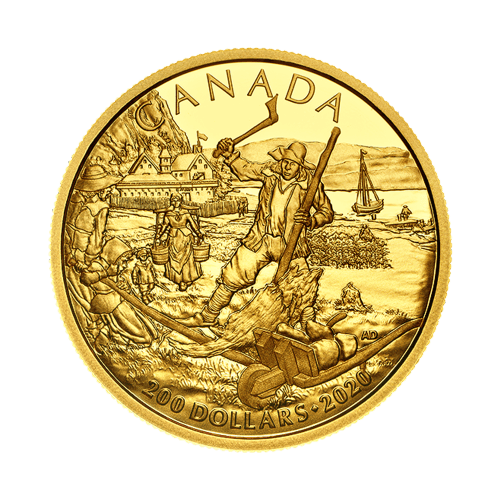
- THIRD ISSUE IN THE EARLY CANADIAN HISTORY SERIES! This coin is a stunning visual narrative of the epic task that confronted Louis Hébert as he cleared the land to establish a garden for Champlain’s Habitation.
- CELEBRATE THE RICH HISTORY OF EARLY CANADA! Collectors of all kinds will cherish this coin on its sheer merits as a work of art that opens a privileged window on the rich cultural heritage of this great country.
- FEATURES A COMPLEX BLEND OF MULTIPLE COIN FINISHES! Each coin features a complex blend of multiple finishes to bring depth to the design and remarkable realism to the textural quality of various elements in the scene—a masterpiece crafted in the beauty of 99.99% pure gold.
- ORDER TODAY! Exquisitely crafted from 99.99% pure gold, this limited collector piece is sure to be a spectacular addition to your collection of gold coins, and will shine bright alongside any historical - or First Nations-themed coins!
DESIGN
Canadian artist Alan Daniel has created a stunning visual narrative of the epic task that confronted Louis Hébert as he cleared the land to establish a garden for Champlain’s Habitation. The undertaking was clearly a family affair as two of Hébert’s children are shown leaning into the pry as Hébert raises his axe to chop the roots of a tree stump. In the background, Hébert’s wife and youngest child approach with water. The location of Hébert’s land as shown in this design is based upon Champlain’s 1608 drawing of his Habitation, the fortifications of which can be seen in the distance in the coin’s design.
ABOUT THE ROYAL CANADIAN MINT
The Royal Canadian Mint is known as one of the most reputable mints in the world. The Ottawa Branch of the Royal Mint opened in 1908 and was renamed The Royal Canadian Mint in 1931 when control was transferred to the Canadian government. Their high standards for excellence and quality allowed them to be the first refinery to manufacture 9999 fine gold bullion coins in 1982, as well as the first to reach 99999 fine gold purity in 1998.
