Pièce 1/4 once d'or 100e anniversaire de l'Aviation royale canadienne 2024 | Monnaie royale canadienne
Related products
Enjoy a look back at the RCAF’s rich history.
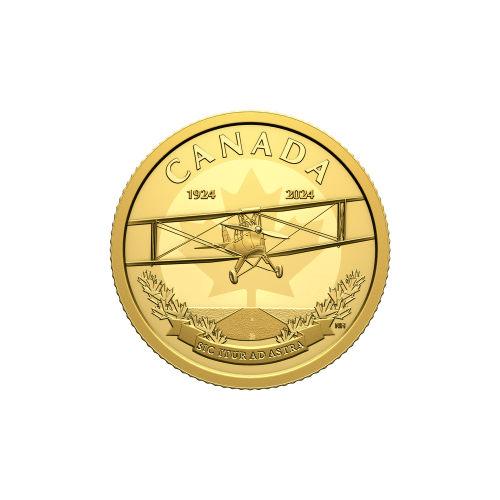
With the creation of the Royal Canadian Air Force (RCAF) on April 1, 1924, Canada gained its first permanent full-time air force, and its early fleet helped develop aviation in Canada. Its formative years and the vital role it played in the British Commonwealth Air Training Plan during the Second World War are represented by the De Havilland DH-82C Tiger Moth depicted on this 99.99% pure gold coin. On the coin’s reverse, the early trainer’s take-off represents the ascent of Canada’s Air Force, while the current motto Sic Itur ad Astra (“Such is the pathway to the stars”) visually connects the RCAF of today with both its future and its storied past.
Pair this pure gold portrait of the RCAF’s past with the 2024 proof dollar. Order your perfect pairing today!
COIN HIGHLIGHTS
- Commemorate the RCAF Centennial. In 2024, we look to the skies and commemorate the Royal Canadian Air Force’s (RCAF) 100 years of service at home and abroad. The RCAF Centennial is an opportunity to honour the history and heritage of Canada’s Air Force, and to recognize its members’ contributions to military and civil aviation, national security and international peace.
- Pure gold portrait of the past. While the 2024 proof dollar covers 100 years of history, this 99.99% pure gold coin focuses on the RCAF’s early years and its contributions to the development of aviation in Canada.
- A design that tells a story. Like the 2024 Fine Silver Proof Dollar, this coin’s design was inspired by the RCAF’s motto appearing on the coin’s reverse, which is the product of a close collaboration between the Royal Canadian Mint, the Royal Canadian Air Force and artist Neil Hamelin.
- Very low mintage. Only 1,500 coins are available to collectors worldwide—don’t wait, order today!
- Includes serialized certificate. The Royal Canadian Mint certifies all of its collector coins.
- No GST/HST.
PACKAGING
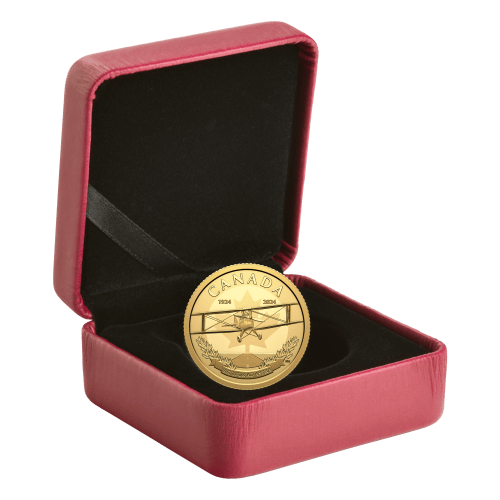
Your coin is encapsulated and presented in a maroon Royal Canadian Mint-branded clamshell with a black beauty box.
MODERN MEETS TRADITIONAL ENGRAVING
Traditional engraving brings the Tiger Moth to life once more on your coin’s reverse, which also features laser engraving and special frosting on the RCAF roundel that provides a fitting backdrop.
DID YOU KNOW?
The De Havilland DH-82C Tiger Moth had just one role: training. It served in about two-thirds of Canadian Elementary Flying Training Schools under the British Commonwealth Air Training Plan. Besides being well suited for pilot training, the Tiger Moth had the ability to perform some aerobatics, and with its larger canopy, it could be used as an instrument flying trainer when the glass was covered.
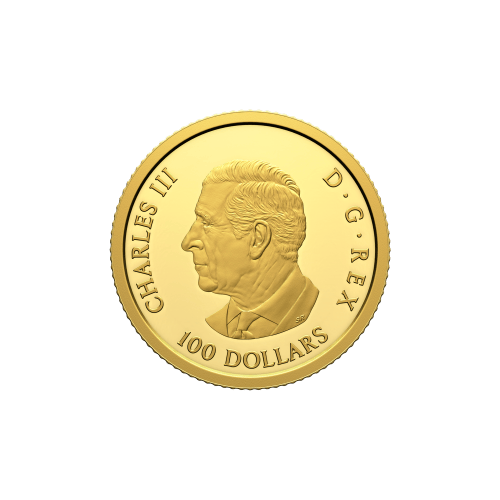
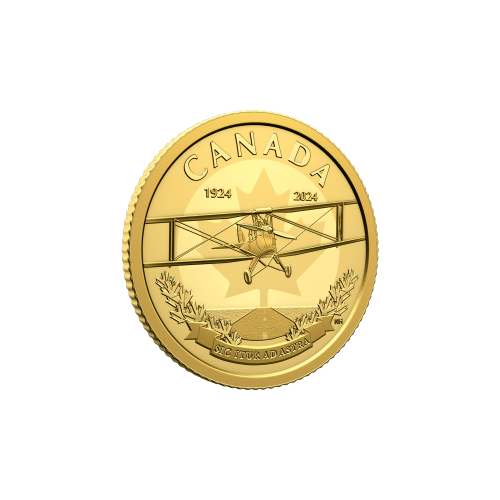
The reverse design by artist Neil Hamelin features the Royal Canadian Air Force (RCAF) roundel in the background, with a proud maple leaf at its centre. The RCAF’s early years are represented by the De Havilland DH-82C Tiger Moth, which was adopted by the RCAF in 1938 and was the last of the Moth trainers the RCAF and civil aviation used in Canada. The Tiger Moth served as one of the basic trainers in Canadian Elementary Flying Training Schools under the British Commonwealth Air Training Plan during the Second World War, when the RCAF developed into the fourth largest Allied air force. Beneath the runway view, the soaring spirit of the RCAF is reflected in the current inspirational motto Sic Itur ad Astra (“Such is the pathway to the stars” in Latin), which is inscribed on a banner accompanied by stylized maple leaves, similar to the current RCAF badge. The obverse features the effigy of His Majesty King Charles III by Canadian artist Steven Rosati.
ABOUT THE ROYAL CANADIAN MINT
The Royal Canadian Mint is known as one of the most reputable mints in the world. The Ottawa Branch of the Royal Mint opened in 1908 and was renamed The Royal Canadian Mint in 1931 when control was transferred to the Canadian government. The Royal Canadian Mint is renowned for producing some of the highest quality and purity of gold and silver bullion coins and bars in the world. Their high standards for excellence and quality allowed them to be the first refinery to manufacture 9999 fine gold bullion coins in 1982, as well as the first to reach 99999 fine gold purity in 1998.
