
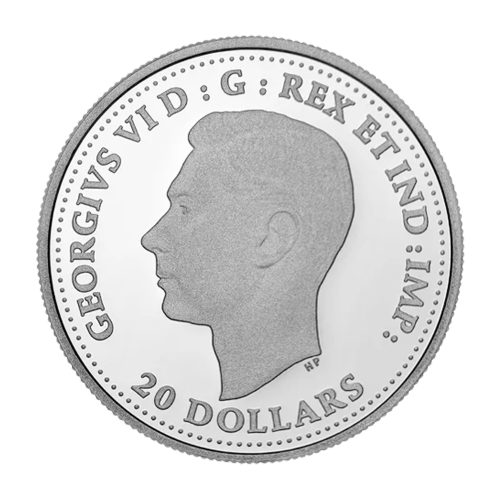


Pièce 1 once d'argent Épreuve numismatique Seconde Guerre mondiale Série Champs de bataille : La bataille de l'Escaut 2019 | Monnaie royale canadienne
Related products
La libération des Pays-Bas commence par l'Escaut. Commandez le vôtre dès maintenant.
« Je dois souligner que, de toutes nos opérations sur l'ensemble de notre front, de la Suisse à la Manche, je considère Anvers comme de première importance... » Message du général Dwight D. Eisenhower, commandant suprême des forces alliées, au maréchal Bernard Law Montgomery, commandant du 21e groupe armé (9 octobre 1944)
Les liens qui unissent le Canada et les Pays-Bas ont été forgés pendant la Seconde Guerre mondiale, lorsque nos histoires se sont entremêlées sur les rives de l'Escaut. La huitième pièce Champs de bataille de la Monnaie royale canadienne commémore le 75e anniversaire de la bataille de l'Escaut (2 octobre - 8 novembre 1944), l'une des principales contributions du Canada à la victoire des Alliés en Europe. Le motif de cette pièce illustre l'intensité d'une bataille où chaque avancée était une lutte mortelle pour s'emparer des hauteurs. Pour la Première armée canadienne, l'Escaut a été la campagne la plus éprouvante de son histoire. Mais pour les Néerlandais, elle a marqué le début de la fin d'une occupation brutale et l'approfondissement d'une amitié entre deux pays.
Commémorez le 75e anniversaire de la bataille de l'Escaut qui a contribué à forger les liens étroits entre le Canada et les Pays-Bas. Commandez le vôtre dès aujourd’hui.
CARACTÉRISTIQUES DE LA PIÈCE
- HUITIÈME PIÈCE DEUXIÈME GUERRE MONDIALE : SÉRIE CHAMPS DE BATAILLE. Cette pièce 1 once rend hommage au 75e anniversaire de la bataille de l'Escaut (1944), une bataille cruciale pour la Première Armée canadienne.
- UNE EFFIGIE HISTORIQUE. Comme toutes les pièces canadiennes émises en 1944, cette pièce en argent pur présente, à l'avers, l'effigie historique du roi George VI (selon T.H. Paget).
- COMPREND L'INSIGNE DE LA PREMIÈRE ARMÉE CANADIENNE. Le fier insigne de la Première Armée canadienne orne le motif et souligne le rôle clé joué par le Canada dans la sécurisation de l'accès au port d'Anvers à l'automne 1944.
- UNE CONSULTATION APPROFONDIE. Nous avons travaillé en étroite collaboration avec des experts militaires et des historiens canadiens et hollandais afin de garantir l'exactitude historique et d'obtenir un motif gravé magnifique, aussi précis que possible.
- UN EMBALLAGE EXCLUSIF POUR L'ENSEMBLE DE LA SÉRIE : Toutes les pièces Seconde Guerre mondiale Série Champs de bataille de la Monnaie royale canadienne (y compris celle-ci) sont emballées dans un boîtier à double coque et une boîte de présentation personnalisée. Collectionnez toutes les pièces de la série et placez les boîtiers dos à dos - ensemble, ils forment une chronologie complète des engagements militaires du Canada pendant la Seconde Guerre mondiale.
- UN CERTIFICAT NUMÉROTÉ INCLUS : La Monnaie royale canadienne certifie toutes ses pièces de collection.
- 1 ONCE D'ARGENT PUR. Cette pièce est fabriquée dans de l'argent pur à 99,99 % !
- TIRAGE LIMITÉ DANS LE MONDE. Seulement 7 500 exemplaires sont disponibles dans le monde.
- AUCUNE TPS NI TVH !
LE MOTIF
Afin de commémorer le 75e anniversaire de la bataille de l'Escaut (1944-2019), l'artiste Mary McPherson présente un portrait réaliste d'un soldat canadien ojibwa au combat à l'automne 1944. L'insigne de la Première armée canadienne apparaît au-dessus du fantassin, qui brandit une mitrailleuse Bren tout en avançant devant un moulin à tour. Un lance-flammes universel Wasp MKII C soutient l'avancée de l'infanterie du haut d'un talus près de l'Escaut. L'avers est à l'effigie du roi George VI selon T.H. Paget.
Le Canada pendant la bataille de l'Escaut (1944)
À l'automne 1944, les lignes de ravitaillement surchargées avaient ralenti l'avancée rapide des Alliés dans le nord-ouest de l'Europe. La sécurisation d'un port en eau profonde plus proche du front était d'une importance capitale. Heureusement, les Alliés s'étaient emparés du deuxième plus grand port maritime d'Europe, Anvers (Belgique), en septembre.
Mais le port est peu utile sans accès à la mer du Nord : les deux rives de l'estuaire de l'Escaut sont tenues par plus de 100 000 hommes parmi les meilleures troupes de la Wehrmacht. C'est donc à la Première Armée canadienne, soutenue par des formations britanniques et polonaises, que revient la tâche de sécuriser ce corridor de 70 kilomètres de long.
Le 2 octobre, la 2e Division d'infanterie canadienne, appuyée par la 4e Division blindée canadienne, lance la première phase de l'offensive le long de la rive nord. Elle prend pied sur l'isthme de Beveland Sud (connu sous le nom de « pays des polders ») avant de nettoyer la péninsule lors de la troisième phase, l'opération Vitality (24-31 octobre).
Pendant ce temps, la deuxième phase (opération Switchback) commence le 6 octobre lorsque la 3e division d'infanterie canadienne se déplace pour nettoyer la poche de Breskens sur la rive sud. Soutenus par l'aviation et l'artillerie britannique, les porte-avions lance-flammes Wasp mènent la charge à travers le canal Léopold, tandis que l'infanterie lance une attaque amphibie le long de la côte.
La phase finale, l'opération Infatuate, voit les Alliés prendre d'assaut l'île de Walcheren, lourdement fortifiée. Les bombardiers ciblent les digues du périmètre et inondent les 4/5 du terrain pour permettre un assaut amphibie. Les Canadiens (et plus tard la 52e division britannique) attaquent le seul accès terrestre de l'île : une chaussée trop étroite pour les chars. Middelburg tombe le 6 novembre ; le 8 novembre, les dernières poches de résistance sont éliminées et une importante opération de déminage est en cours dans l'Escaut.
LE SAVIEZ-VOUS ?
- Le terrain est plat et les routes sont construites sur les digues et autres remblais... tout comme les défenses ennemies. Les armes sont souvent placées sur les pentes inversées (arrière), y compris les lance-roquettes meurtriers Nebelwerfer. Les arbres sont coupés et placés dans les champs, puis reliés par du fil de fer barbelé et des mines ; surnommés « asperges de Rommel », ils constituent des obstacles mortels pour les parachutistes. Des mines sont également posées sous les routes principales, tandis que des digues sont creusées pour inonder les basses terres.
- Les Canadiens apprennent rapidement qu'ils ne peuvent pas creuser de trous de renard ou de tranchées de plus d'un pied de profondeur avant que l'eau ne les remplisse. Le froid n'atténue guère les conditions humides, tandis que la boue ralentit les hommes et les machines.
- Le Canada subit un total de 6 367 pertes au cours des cinq semaines de la bataille, dont 3 650 hommes de la 2e Division canadienne.
- Le 13 octobre 1944, le « vendredi noir », la compagnie de tête du Black Watch Regiment subit le deuxième pire désastre en une seule journée de l'histoire du régiment. La compagnie, qui comptait 90 hommes, ne comptait plus que quatre survivants, et ses quatre commandants figuraient pari les victimes.
- Un cargo construit au Canada, le SS Fort Cataraqui, a été le premier navire de ravitaillement allié à arriver à Anvers le 28 novembre 1944.
- L'ennemi espérait reprendre Anvers en lançant une grande offensive en décembre 1944 : la bataille des Ardennes, également connue sous le nom de « bataille du Saillant ».
- Poussant à travers la France et la Belgique, la Première armée canadienne a pour mission de nettoyer les zones côtières, notamment en mettant hors d'état de nuire les sites de lancement de fusées V qui avaient visé le sud de l'Angleterre. Mais le port d'Anvers devient rapidement la cible suivante pendant la bataille de l'Escaut - en fait, c'est la ville la plus visée entre le 14 octobre 1944 et le 30 mars 1945, quand environ 1 214 bombes volantes V-1 et fusées supersoniques V-2 frappent le port contrôlé par les Alliés.
À PROPOS DE LA MONNAIE ROYALE CANADIENNE
La Monnaie royale canadienne est connue pour être l'une des monnaies les plus réputées au monde. La succursale d'Ottawa de la Monnaie royale a ouvert ses portes en 1908 et a été rebaptisée Monnaie royale canadienne en 1931 lorsque le contrôle a été transféré au gouvernement canadien. La Monnaie royale canadienne est réputée pour produire des pièces et des lingots d'or et d'argent d'une qualité et d'une pureté parmi les plus élevées au monde. Ses normes élevées en matière d'excellence et de qualité lui ont permis d'être la première raffinerie à fabriquer des pièces d'investissement en or d'une pureté de 9999 en 1982, ainsi que la première à atteindre une pureté de 99999 en 1998.
