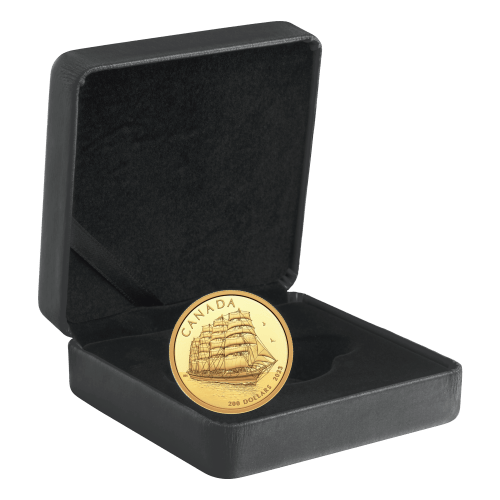
Pièce 1/2 once d'or Grands navires : Voilier à gréement carré 2023 | Monnaie royale canadienne
Related products
The Royal Canadian Mint's second tall ship has all the sails and spars it could carry. Order Coin #2 today!
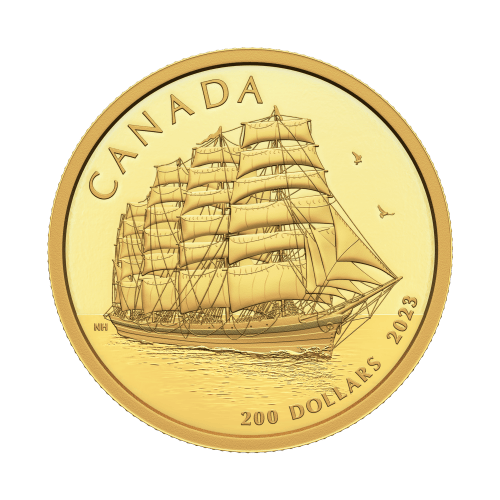
With its iconic triangular staysails and square-rigged sails on all three (or more) masts, a full-rigged ship—like the one featured on the second Tall Ships pure gold coin—inspires a sense of dignified magnificence. That full complement of sails, so beautifully depicted on the coin’s reverse, makes it ideal for hauling goods and people over great distances and across deep seas, even in unpredictable conditions. The full-rigged ships of the 18th, 19th, and even 20th centuries facilitated the development of Canada—from the frigates built to defend these shores, to the cargo-carrying ships that supplied this fledgling nation.
Grow your fleet by adding a second Tall Ships coin to your collection.
COIN HIGHLIGHTS
- Coin #2. The annual Tall Ships series of pure gold coins celebrates the legendary vessels that drew international acclaim for Canada’s shipyards and contributed to our rich maritime heritage.
- Back to the golden age of sail. Each instalment showcases a different type of tall ship or sail plan, beginning with the brigantine on the 2022 coin (Coin #1) and continuing with the full-rigged ship featured here.
- Tall ships: a popular theme. A prestigious addition to any collection, especially a gold, history or nautical-themed one.
- Includes serialized certificate. The Royal Canadian Mint certifies all of its collector coins.
IMPECCABLE CRAFTSMANSHIP
Every Tall Ships coin is an expertly engraved and exquisitely detailed portrait of Canada’s past. These are the wooden ships that shaped the course of Canada’s history, and they served as a testament to our nation’s seafaring traditions and shipbuilding prowess.
PURE GOLD PORTRAIT
This low mintage (800) coin is crafted from 99.99% pure gold. Its luminous, mirror-like finish lights up the engraved art on the coin’s reverse.
DID YOU KNOW?
- Today, North Star of Herschel Island is Canada’s only full-rigged ship. Built in 1935 for Inuvialuit trappers, the Arctic tall ship was the largest private vessel in the Western Arctic and was used to transport pelts to market and supplies to Sachs Harbour, the ship’s home port. Following a refit, North Star was used for scientific exploration in the Arctic Ocean from 1968 to 1973, and for surveying the British Columbia-Alaska boundary. Canada’s Arctic tall ship now calls the Pacific coast home, where North Star delights and educates those who wish to learn more about the ship’s place in Canadian history.To learn more, visit www.northstarofherschelisland.ca
- Another full-rigged ship, Hector, brought the first wave of emigrants directly from Scotland to Nova Scotia in 1773, earning it the moniker “Canada’s Mayflower.” After more than 11 weeks at sea, the three-masted fluyt (a Dutch-designed, square-rigged cargo vessel) landed near Pictou, N.S., on September 15, 1773. The late arrival date forced Hector’s passengers—originally 189 but 18 died during travel—to quickly build shelter before winter set in. The people of the Mi'kmaq First Nations community helped the settlers, teaching them vital survival skills. Many settled close to the shore and contributed to the development of Pictou, N.S., “the birthplace of New Scotland,” where a full-sized replica of Hector is open to the public at Hector Heritage Quay.
DESIGN & ARTIST
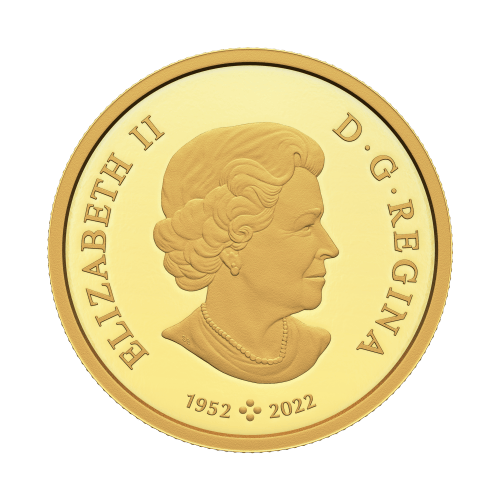
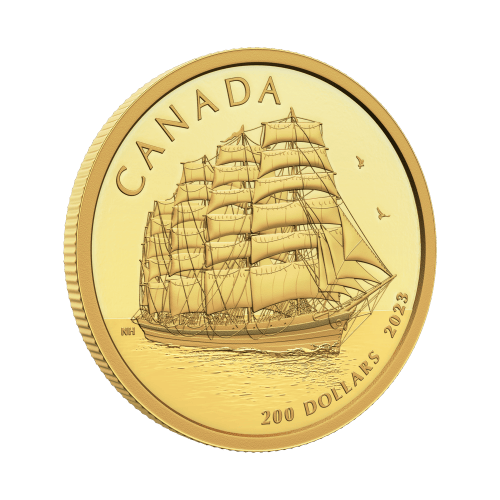
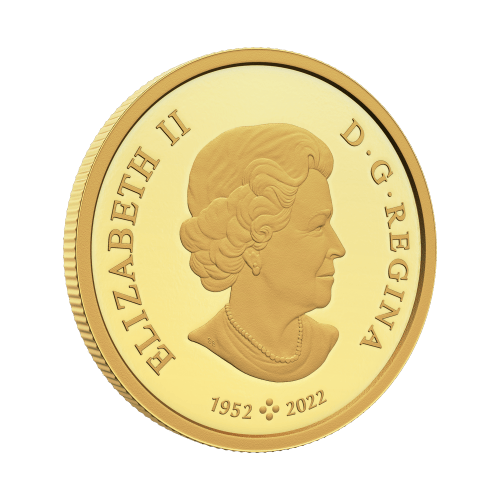
Inspired by the ships from Canada’s past, the reverse design by Canadian artist Neil Hamelin features an early morning view of a full-rigged ship sailing in calm waters with all sails set. The reverse includes the word “CANADA”, a face value of “200 DOLLARS” and the year “2023”. The obverse features the effigy of Queen Elizabeth II by Susanna Blunt. The obverse also bears a special marking that includes four pearls symbolizing the four effigies that have graced Canadian coins and the double date of her reign.
"The decision was made to compose the ship in a way that showcases all its masts. Selecting a calmer moment at sea meant I could hang all the sails out and capture the feeling of awe that seeing a vessel like this elicits, and it tells the story of an early morning under sail." NEIL HAMELIN
"A full-rigged ship carrying square sails on each of her three or more masts was a common rig for cargo ships in the 19th century, as the sails could be efficiently configured for trade wind sailing. One of the most famous ships to carry this rig was HMS St. Lawrence, which was built at the Royal Navy Dockyard in Kingston, Ont., in 1814 and had been intended for use during the War of 1812. The largest fully-rigged ship ever built in Canada was W.D. Lawrence; built at Maitland, N.S., in 1874, W.D. Lawrence eclipsed Marco Polo, which had been built in Saint John, N.B., in 1851. Today, the three-masted fully-rigged ship North Star of Herschel Island operates on Canada's West Coast." R. BRUCE MACDONALD, AUTHOR AND CAPTAIN OF NORTH STAR OF HERSCHEL ISLAND
PACKAGING
Each coin is individually encapsulated and presented in a black Royal Canadian Mint-branded clamshell with a black beauty box.
ABOUT THE ROYAL CANADIAN MINT
The Royal Canadian Mint is known as one of the most reputable mints in the world. The Ottawa Branch of the Royal Mint opened in 1908 and was renamed The Royal Canadian Mint in 1931 when control was transferred to the Canadian government. The Royal Canadian Mint is renowned for producing some of the highest quality and purity of gold and silver bullion coins and bars in the world. Their high standards for excellence and quality allowed them to be the first refinery to manufacture 9999 fine gold bullion coins in 1982, as well as the first to reach 99999 fine gold purity in 1998.
