Pièce d'argent VG Dollar de la Paix Année aléatoire | Monnaie des États-Unis
Related products
Secure your Random Year Peace Silver Dollar VG Silver Coin and grow your wealth today!
COIN HIGHLIGHTS
- Ships individually in protective packaging
- Consisting of 0.7734 oz of 900 Fine Silver
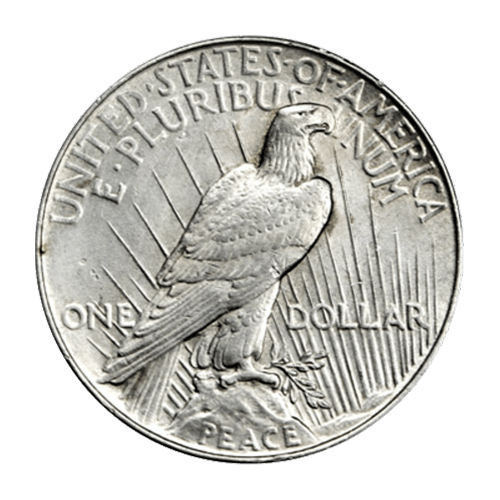
- Obverse: Features a depiction of an intricate American Eagle perched atop a rocky outcrop holding an olive branch as the sun rises across the coin's field, the inscriptions "UNITED STATES OF AMERICA," "E PLURIBUS UNUM," "ONE DOLLAR", and "PEACE"
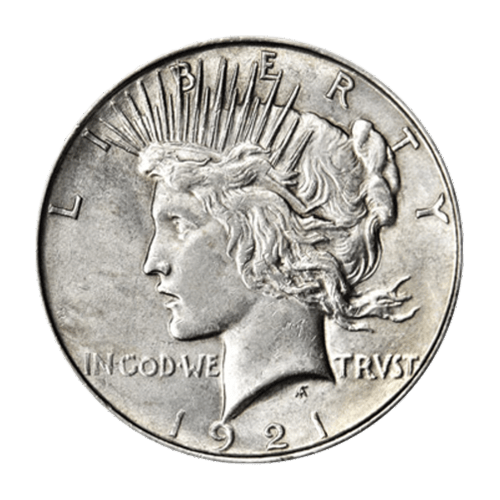
- Reverse: Features a depiction of a left-facing Lady Liberty, the inscriptions "LIBERTY," and "IN GOD WE TRUST" along with the year of release
The Morgan Silver dollar is a sound investment as it holds both bullion and numismatic value. The “VG” designation ensures that the coin that you receive will be in very good condition and exhibit normal wear and tear.
The Peace dollar was minted from 1921-1928, as well as 1934-35. It was the last regular production dollar struck in silver. The Peace dollars were produced with ninety percent silver and ten percent copper in order to conform with the coinage act of 1837. In 1962 a silver certificate was partially redeemed for an uncirculated Morgan dollar, which set off a firestorm of interest in redeeming silver certificates to the US Treasury. Demand was huge, with some in lines pushing wheelbarrows. Several million uncirculated Morgan and Peace dollars were eventually discovered in vaults and sold off to the public.
The 1918 Pittman Act instructed the U.S. Mint to melt up to 350,000,000 silver dollars into bullion and to use the proceeds to purchase bullion to coin a like number of coins. The melt bullion was sold to England at $1 per ounce, and then newly mined silver was purchased from U.S. silver mines at $1 per ounce. This was above the market selling price of silver and acted as a federal subsidy to the silver mining industry. It appears that cronyism never goes out of style!
Coinciding with the passage of the Pittman Act, a movement started to issue a coin to commemorate the peace after WW I, and that such a victory coin be "issued in such quantities it will never become rare."
Production of the Morgan dollar re-started in 1921 as called for by the Pittman Act, and a competition was held to find its replacement. The winner of the competition was Anthony de Francisci, who used his wife Teresa as his model. The obverse features Lady Liberty with a crown meant to resemble that on the Statue of Liberty. The studio window was open when de Francisci worked, hence the blowing hair of Lady Liberty on the coin.
ABOUT THE UNITED STATES MINT
Established in 1792 as the first national mint in the United States, the United States Mint is a bureau of the Department of the Treasury responsible for official legal tender coinage production. The United States Mint has a mission to serve Americans as the sole manufacturer and distributor of circulating currency coins. The U.S. mint also produces commemorative coins for collectors, silver and gold bullion coins for investors (such as the popular Eagle and Buffalo series), as well as Congressional Medals.
